
The Core Idea
When situations feel personal or pressured, two things tend to happen:
Identity gains authority
“This says something about me.”
Resistance appears
“This shouldn’t be happening.”
Together, they create interference in the form of stress, mental noise, urgency, self-judgement, and reactivity.
But as identity loosens and resistance drops, interference reduces.
When interference reduces, clarity tends to return and stress often falls away.
The Interference Window
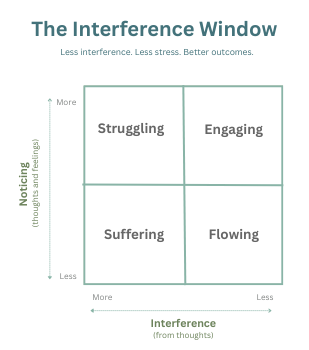
The Interference Window describes states you may be experiencing. We move through them all at some point.
Suffering
High interference from thoughts. Things feel personal and overwhelming.Struggling
Some awareness of thoughts and resistance, but effort and friction are high.Engaging
Interference has reduced. You’re aware of thoughts, but they’re not in control. Stress starts falling away.Flowing
Minimal interference. Action feels natural and unforced.The aim of the window is just to notice what’s happening, and offer steps to help reduce stress.
To Move Around the Window:
1) Awareness: Notice the thought/feeling
2) Drop resistance to it being there
3) Respond (don’t react) : Act deliberately
In the moment, say quietly : “I am open to this”
Every experience has two layers:
Situation: What is happening
Story: What your mind adds
What reduces interference (and reduces stress)?
Interference drops when:
• identity and thoughts have less authority/importance
• there is more openness to what’s actually happening
Openness doesn’t mean liking, agreeing, or giving up. It simply means stopping the internal fight and being open to what’s happening.
When the fighting eases, clarity tends to return on its own.
Some people find it helpful to quietly orient to saying something like:
“I’m open to this.”
This isn’t a mantra or something to repeat. It’s just one way of describing the shift from resistance to openness.
How to use this site
This site exists as a simple reference you can return to when things feel personal, pressured, or unclear. Or to build awareness during calmer times so you’re more ready for the bigger challenges when things spike.
You don’t need to read everything or follow a sequence. Start wherever (or whenever) something resonates.
Use what helps. Leave the rest.
The Interference Window works best when it’s used lightly. These pages and PDFs are not techniques to apply, or practices to perfect. They are ways of noticing what’s already happening, especially when stress or urgency is present.
If clarity shifts, that’s useful. If nothing changes, that’s fine too. You’re not meant to manage yourself here. Just orient, notice, and let interference soften in its own time.
How to use the model
When something feels personal or pressured, you can ask:
Where am I in the Interference Window right now?
What’s adding interference:
identity? (and attachment to it)
resistance? (against what’s happening)
or urgency? (the sense that something needs to be done now)
Often, noticing this is enough to shift how much grip it has.
This is especially useful when:
the situation matters
you can’t step away
effort is high but clarity is low
It’s a way of seeing what’s happening, a reference you can return to, and something you can test in real life that may help ease stress.
If this is useful, take it with you.
If it’s not, leave it here.
Using it with support (optional)
Some people find it helpful to talk this through in real situations.
For a small number of people, I offer ‘Clarity Sessions’. These are quiet, practical conversations using the Interference Window to reduce noise and restore perspective.
There’s no commitment and no expectation to continue.
This may not be for you - that’s ok
This won’t resonate with everyone. It’s not meant to.
It’s here to be available when things feel personal.
Take the test
Interested in finding out where on the window you are right now?
Take the 3 minute quiz below for an instance assessment.